
Introduction
Esports—competitive video gaming at a professional level—is no longer a niche hobby. It has rapidly transformed into a global phenomenon, with players, teams, sponsors, and fans all contributing to a vibrant ecosystem. What once began with local LAN parties and small online tournaments has grown into stadium-filling events, multi‑million dollar prize pools, and careers for those who might never touch a traditional sports ball.
In this blog post, we will take you on a deep dive into the world of esports: how it evolved, how its structure works, what training looks like, the business side of the industry, and how it is shaping the future of entertainment and competition. Whether you’re a casual fan, an aspiring pro gamer, or someone curious about the mechanics behind the scenes, this post aims to give you a detailed and engaging overview.
A Brief History of Esports
From Arcades to Online Arenas
The roots of competitive gaming trace back to arcade tournaments and early console contests. But the real turning point came with the rise of the internet and online multiplayer capabilities. Titles like Quake, StarCraft, Counter‑Strike, and Warcraft III ushered in competitive communities, ladder systems, and clan vs. clan matches.
Over time, as connectivity improved and gaming culture mainstreamed, more people began watching others play. Streaming platforms and social media helped broadcast skillful matches to millions. Gradually, sponsors, prize money, and professional teams emerged, and what was once underground grew into a formidable industry.
Key Milestones
- The first televised gaming tournaments and early esports leagues in the late 1990s and early 2000s.
- Emergence of dedicated esports organizations (teams) that signed players, managed contracts, and competed in multiple games.
- Rise of streaming platforms like Twitch, YouTube Gaming, etc., which allowed fans to watch live gameplay and tournaments.
- Massive global events with prize pools reaching millions of dollars, broad media coverage, and corporate investments.
The Ecosystem of Esports
Esports is more than just players sitting in front of screens. A complex ecosystem supports and enables the competitive scene. Below are the primary components and how they interrelate.
Game Developers & Publishers
At the foundation, there’s a game. Esports can only exist where a game’s rules are balanced, competitive, and quantifiable. Developers create the mechanics, art, and systems, while publishers often fund, market, and maintain the game. In many cases, publishers also control the licensing, rules, and competitive direction of pro tournaments.
Tournament Organizers & Leagues
While publishers sometimes run official events, many tournaments are arranged by independent organizers. These bodies handle logistics, format, match scheduling, venue procurement (for in‑person events), broadcasting, prize distribution, and marketing. Leagues provide ongoing competition—regular seasons, promotion/relegation systems, regional circuits—so that the competitive scene has continuity rather than only one-off events.
Teams and Organizations
Esports teams (or organizations) recruit and manage players, coaches, staff, and infrastructure. They train in bootcamps, manage sponsorship deals, brand partnerships, content creation, and marketing. Top organizations are often multi‑game, with rosters competing across multiple titles.
Players & Coaches
Players are the front-line talent. They must master the mechanics, strategy, communication, and mental resilience to perform under pressure. Coaches and analysts help design strategy, review replays, guide improvement, and manage morale.
Media, Streaming & Content
To attract fans, esports needs content. That comes from live broadcasting, commentators (casters), analysts, highlight reels, behind‑the-scenes content, interviews, and social media. Streaming platforms are the lifeblood: they connect tournaments to fans far beyond the venue.
Sponsors & Investors
Brands see value in visibility to a young and engaged audience. Sponsors fund teams, tournaments, influencers, and broadcast infrastructure. Investors often help scale operations, build studios, or create esports‑adjacent startups like management platforms or analytic tools.
Fans & Viewers
Without an audience, esports would have no value. Fans watch live matches, follow teams, interact in chat, purchase merchandise, and shape the popularity of games and players. Fan engagement often drives sponsorship investment and the viability of events.
Supporting Roles
Beyond the more visible parts, many supporting roles are essential: event staff, production crews, broadcast engineers, PR & marketing professionals, legal and financial teams, platform engineers, and anti‑cheat security teams.
The Structure & Business of Esports
Revenue Streams
Esports organizations and events often combine multiple income sources:
- Sponsorships & brand deals
- Media rights and broadcasting deals
- Ticket sales (for live events)
- Merchandise and apparel
- Prize winnings (for teams)
- Streaming revenue or content monetization
- Affiliate marketing or in‑game tie‑ins
Organizational Structure
A mature esports organization often has hierarchies with distinct departments:
- Management / Executive leadership
- Competitive operations (coaches, analysts, player development)
- Content & media (video, social media, marketing)
- Business development & sponsorship
- Production & studio (broadcast, technical operations)
- Legal, finance, and HR
Divisional models may separate by game title or region. This structure ensures specialization and clarity in operations. Organimi
Business Challenges & Risks
- Game lifecycles are unpredictable: games can fall out of favor or be shut down.
- Dependency on publishers: rule changes, balance updates, or license restrictions can impact competitive viability.
- Financial sustainability: prize pools, sponsorships, and ad revenue need consistent growth to support teams.
- Burnout and turnover: players often have short careers because of stress and performance demands.
- Regulatory and legal uncertainties: issues like player contracts, gambling, broadcasting rights, and global taxation can complicate operations.
Performance, Training, and Player Development
What does it take to become or maintain status as a top esports competitor? It’s more than just playing a lot.
Performance Framework
Recent research proposes a performance structure for esports that blends game‑specific skills with principles drawn from sports science. EHPI
Key domains include:
- Tactical-cognitive abilities: decision-making, strategy, memory, adaptation under changing conditions
- Motor skills and coordination: clicking, aiming, movement precision
- Sensory processing: visual, auditory, and haptic (feedback) perception
- Mental and psychological resilience: focus, stress management, handling pressure
- Health, sleep, nutrition: maintaining physical well‑being helps sustain high performance
- Media competence: players must also interact with streaming tools, broadcast protocols, and content systems
Interestingly, research finds that many elite players train up to 37 hours per week, while the average might be around 14 hours. EHPI
Training Methods
Training in esports is multifaceted:
- Mechanics drills (aim training, reaction time, micro‑skill practice)
- Strategy and meta learning (study patch notes, theorycrafting)
- Replay review and VOD analysis with coaches
- Scrims (practice matches) against other teams
- Communication and teamwork drills
- Physical fitness and wellness routines (some teams incorporate exercise, stretching, and eye care)
- Mental conditioning (visualization, meditation, stress control)
Because esports is inherently digital, it requires unique training methods suited to each game’s demands.
Player Development & Academies
Top organizations now run academy teams or junior divisions. These allow emerging talent to polish skills, gain exposure, and learn team culture before being promoted to a main roster. Some regions also have amateur circuits or student leagues that serve as feeders to pro levels.
Major Titles & Genres in Esports
Although new games emerge regularly, a few genres dominate:
- First-Person Shooters (FPS): Counter-Strike series, Valorant, Overwatch
- Multiplayer Online Battle Arena (MOBA): League of Legends, Dota 2
- Real-Time Strategy (RTS): StarCraft II
- Battle Royale & Survival: Fortnite, Apex Legends
- Sports / Racing Simulations: FIFA, Rocket League
- Fighting games: Street Fighter, Super Smash Bros
Each genre has its own competitive norms, community, balance demands, and viewer preferences.
Spotlight on Global Events & Prize Pools
Major tournaments attract global attention, where teams compete for prestige, media coverage, and large prize pools.
For example:
- The League of Legends World Championship
- The International (Dota 2)
- CS:GO Majors
- Valorant Champions Series
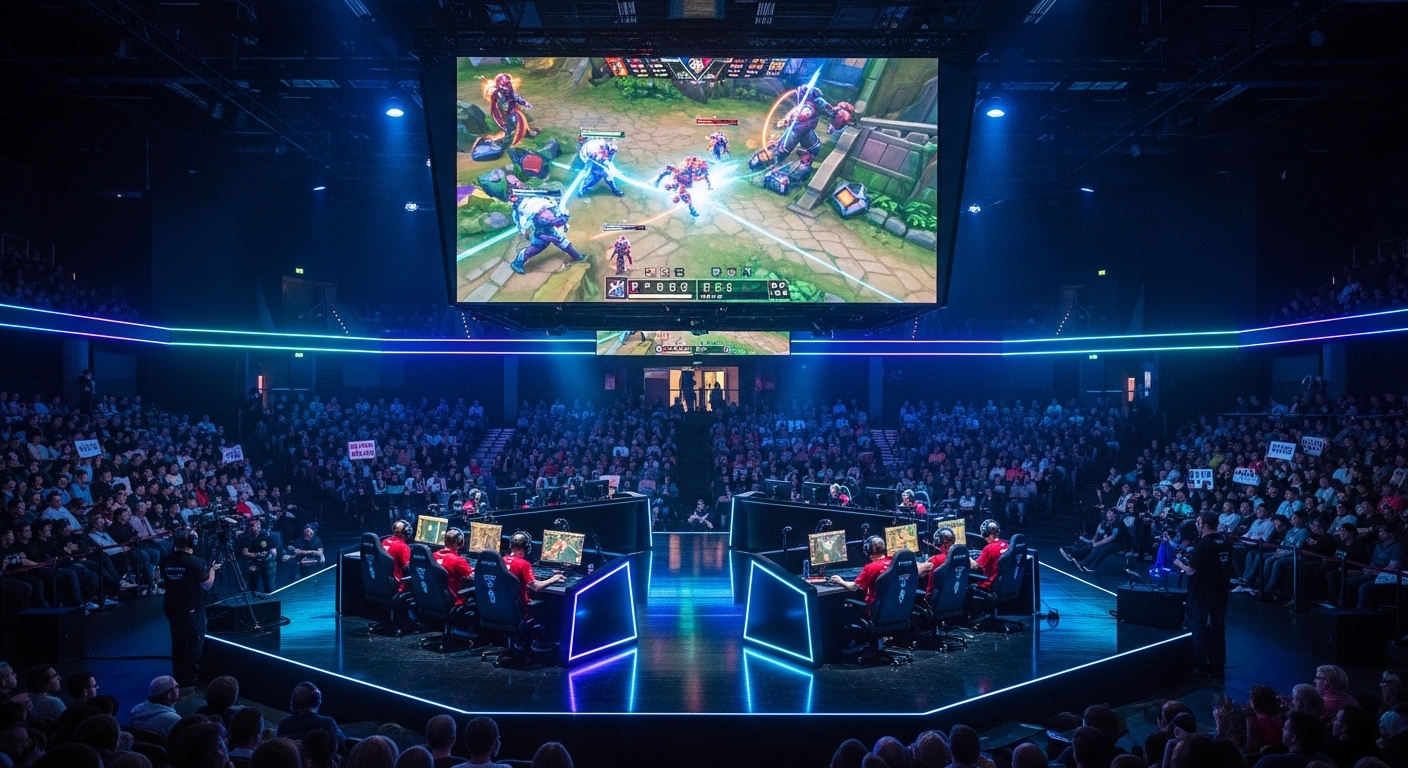
Prize pools can reach millions of dollars. Events often span multiple days, with group stages, knockout brackets, and finals in large arenas attended by tens of thousands of fans.
These events also serve as marketing spectacles — sponsors, activations, broadcasting, fan zones, merchandising — all combining to create an immersive experience for fans and participants.
The Fan Experience & Community
Spectating & Broadcast
Good casting (commentary), analysis desks, player cams, replay visuals, and dynamic overlays are essential to making esports watchable. A casual viewer must understand the flow of a game even if they lack deep knowledge.
Behind the scenes, production crews, directors, observers, replay operators, graphics teams, and audio engineers coordinate to deliver a polished broadcast.
Community Content & Social Media
Clips, memes, highlight reels, player interviews, behind-the-scenes videos, podcasts, and social media posts keep the community engaged between tournaments. Teams and players often produce their own content to build personal brands and fan connection.
Grassroots & Amateur Scenes
Local tournaments, LAN cafes, community hubs, and online ladders feed talent into higher levels. Esports is only sustainable when there’s a vibrant base of casual and amateur players and organizers.
Challenges & Criticisms
Stability & Sustainability
Because esports revolves around digital platforms and games decided by publishers, teams and events are vulnerable to changes in game direction, legal decisions, or declining popularity.
Player Health & Longevity
Repetitive strain injuries (RSI), burnout, mental fatigue, and stress are real threats. Without structured physical and psychological support, many players retire early.
Inclusion & Diversity
Historically, many esports scenes have lacked gender diversity or had issues with toxicity, harassment, or lack of inclusion. Addressing these requires robust community moderation, inclusive policies, and role models.
Regulatory & Ethical Issues
Gambling, match fixing, cheating, doping (in some cases), streaming rules, contract disputes, and global taxation all pose legal and ethical challenges for the industry.
The Future of Esports
Technological Innovations
- Virtual Reality (VR) and Augmented Reality (AR) esports experiences
- AI-driven coaching and analytics tools
- Better streaming infrastructure, lower-latency broadcasting
- Cross‑platform titles and cloud gaming expansion
Integration with Traditional Sports
Some traditional sports teams and franchises are investing in or owning esports teams. The convergence of media rights, broadcasting, and brand synergy could reshape how entertainment is delivered.
Educational & Institutional Support
More universities are offering esports scholarships, collegiate leagues, and academic programs in gaming, media, or digital entertainment. The formalization of esports as an academic and career path is growing. Wikipedia
Mainstream Recognition
Esports may increasingly appear in multi-sport events, broadcasting on prime channels, and potentially gaining recognition in larger sporting contexts (e.g. inclusion in regional games or exhibitions).
How to Get Involved (as a Player, Organizer, or Fan)
As a Player
- Choose a game you enjoy and invest in mastering it
- Study replays, follow professional matches, and adopt disciplined practice
- Join local tournaments, ladder systems, and find scrims
- Build a social presence — stream, post content, engage with community
- Keep health in check: balance, rest, nutrition, and mental well‑being
As an Organizer
- Start small with local or online events
- Focus on fair rules, smooth administration, and good production
- Build trust with teams, players, and sponsors
- Learn broadcasting, streaming, and marketing best practices
- Scale gradually and maintain sustainability
As a Fan & Content Creator
- Watch broadcasts with interest, engage in chat, attend events
- Create content: reactions, analysis, memes, tutorials
- Support teams via social media, merchandise, fan communities
- Engage responsibly: respect players, encourage positive behavior
Conclusion
Esports is far more than people staring at monitors. It’s a dynamic ecosystem driven by skill, strategy, technology, entertainment, and community. For those willing to dig deeper, the industry offers a playground of opportunities: from competitive careers and content creation to business ventures and event production.
As it continues to mature, esports will likely blur further with mainstream entertainment, innovate through technology, and provide ever more immersive experiences. Whether you’re watching your favorite team chase a championship, dreaming of joining the pro ranks, or thinking of starting your own esports venture, one thing is clear: the digital arena is where the future of competition is being written.